
Professional Game Referees (Pro Ref)

30th June 2026
English referees are to undergo a corporate rebrand next season, with their organisation PGMOL to be known as “Pro Ref”.
It is jointly owned by the Premier League, the Football League (EFL) and the Football Association. The body oversees officials in the Premier League, the EFL, the National League, the Women’s Super League and the Under-21s Premier League 2.
WHUST attended a session this evening hosted by The Football Supporters Association with Pro Ref for representatives from supporter groups to understand the changes. Ben Campbell from Pro Ref gave a presentation on the changes. Ben is Head of Communications for Pro Ref – prior to joining them Ben spent 4 years at West Ham finishing as Head of Communications before joining the then PGMOL in 2022.
Elevating the Standard: How Pro Ref is Transforming Modern Football Officiating
The landscape of professional football has evolved dramatically over the last five to six years. The modern game is faster, more technical, and under a sharper analytical microscope than ever before. To keep pace with this high-velocity shift, England’s refereeing infrastructure is undergoing its most significant structural and cultural transformation in decades.
Led by Chief Operating Officer Danielle Every and Chief Refereeing Officer Howard Webb, Pro Ref is moving beyond the legacy structures of the past. This evolution is driven by a deep-seated commitment to high performance, transparency, and elite support networks.
A High-Performance Infrastructure
Officiating is no longer just about knowing the laws of the game; it requires an elite athletic mindset. Referees today operate in a high-performance ecosystem comparable to the clubs they officiate. Supported by a three-year financial plan backed by the Premier League, the FA, the EFL, and the WSL, Pro Ref has expanded its organisational strength to roughly 700 personnel.
Since 2022, between 80 and 100 dedicated support staff have been integrated into the organisation. This injection of resource directly impacts matchdays by pairing officials with a robust network of:
Specialist Coaches: The coaching ratio has been optimized to one coach per six referees, offering a level of bespoke guidance that rivals or exceeds professional club setups.
Data Analysts: Utilising cutting-edge training technologies to capture marginal performance gains.
Sports Psychologists & Nutritionists: Ensuring officials are physically and mentally optimised to handle high-pressure environments.
The physical demands are clear: Premier League data shows a massive uptick in high-intensity metres covered and top sprint speeds by officials, coinciding with a notable decrease in injuries and higher fitness test pass rates.
Streamlining the Elite Pathway
To eliminate the confusing nomenclature of the past (such as "Select Group 1" or "Supplementary Lists"), Pro Ref has streamlined its refereeing tiers into six highly focused operational groups. The most important change affecting West Ham is the introduction of the Professional Referee Group which will now combines the EFL Championship with the Premier League for the pool of officials
|
Group Name |
Operational Focus |
|
Professional Referee Group |
Full-time officials handling the Premier League and the Championship. |
|
National Group |
Referees serving League One, League Two, and the National League. |
|
Women’s Pro Game Group |
Dedicated officials for the WSL and WSL 2. |
|
Future Talents Group |
A joint venture with the FA designed to scout and fast-track high-potential talent. |
|
CoreX |
A dedicated group providing opportunities for officials from historically underrepresented backgrounds. |
|
Player to Match Official Program |
Fast-tracking former professional players (such as Liam Trotter and Chris Birchall) into officiating. |
The Dynamic "Reserve Team" Philosophy
Historically, the referee promotion ladder was rigid; a single lower mark could halt an official's progression. Today, Pro Ref employs a modern, dynamic pathway.
Much like blooding an academy player in a senior squad, talented officials from lower divisions are handed opportunities to officiate four to ten games at a higher level to test their readiness without the pressure of immediate, permanent promotion. A prime example of this fluidity is referee Fai Hallam, who successfully transitioned into a full-time role within the Professional Referee Group after a series of high-profile, confident performances.
Diversity and Next-Generation Recruitment
The pool of registered referees in England has grown from 32,000 to 41,500 over the last four years. The elite officials operating in the professional game represent the top 1.5% of this national workforce.
Crucially, grassroots outreach and targeted initiatives like the "Breaking Barriers" events—hosted at major football league grounds—are radically changing the demographic of English refereeing. Over a three-year period, representation of women and officials from historically under-represented backgrounds across the professional game has jumped from 6–7% to an impressive 21%. Emerging talents like Emily Carney, now an assistant referee in the Championship, highlight a broadening, highly competitive pool of elite female officials.
Accountability and the Myth of "Marking Your Own Homework"
A frequent critique of refereeing bodies is a perceived lack of public accountability. To counter this, Pro Ref relies on strict independent scrutiny.
Referees do not grade their own performances. Key match decisions are evaluated by an independent Key Match Incidents (KMI) Panel.
The KMI Panel consists of five experts, three of whom are entirely independent of Pro Ref, the EFL, and the Premier League—typically featuring former players, managers, and elite coaches. Out of thousands of complex, split-second decisions evaluated across a grueling 38-match-round season, the independent panel recorded only 25 definitive errors last year, highlighting an incredibly high baseline of accuracy.
Bridging the Gap: Communication and Technology
Rather than remaining aloof, Pro Ref is actively prioritising stakeholder collaboration and communication.
Pre-Season & Mid-Season Squad Visits: Technical leadership teams—including Howard Webb, Hugh Dallas, Andre Marriner, and Technical Director Adam Watts—conduct in-person workshops with every Premier League squad. Managers, captains, and players are briefed extensively on rule interpretations and operational approaches to ensure complete alignment before a ball is kicked.
The Evolution of VAR: While accuracy remains paramount, efficiency and stadium communication are being heavily targeted. Statistically, VAR intervention delays have decreased, averaging roughly 45 seconds of delay per match last season. The introduction of live stadium announcements by on-field officials ensures that supporters inside the ground are kept informed of the rationale behind critical reviews.
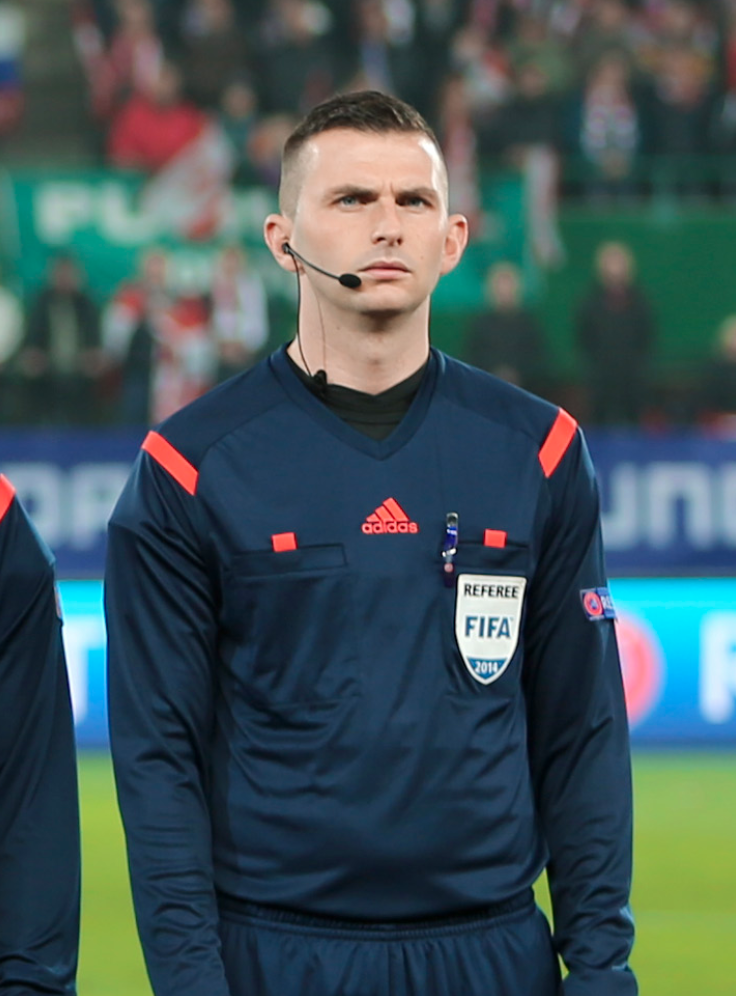
Thirty-seven Pro Ref match officials are on the FIFA International List of Match Officials. This is a global register of referees, assistant referees and video match officials who are qualified to officiate at an international level in FIFA competitions. Officials on this list are entitled to wear the FIFA badge for the year they are enlisted.
Michael Oliver
Manfred Werner - Tsui, CC BY-SA 3.0, via Wikimedia Commons
.jpg)